Queueing
Kueue is the only part of this system that decides when a campaign may run. It owns admission and GPU quota, and knows nothing about HTR, IIIF or S3. A campaign is one Indexed Job, and so one Kueue Workload, not one per index. Most of this page follows from that fact.
Kueue is a job-level admission controller and quota manager. It is not a
pod scheduler. It never picks a node or binds a pod, and campaign pods keep
schedulerName: default-scheduler. Kueue decides when, kube-scheduler
decides where. The Kueue release the Makefile installs is KUEUE_VERSION.
Topology
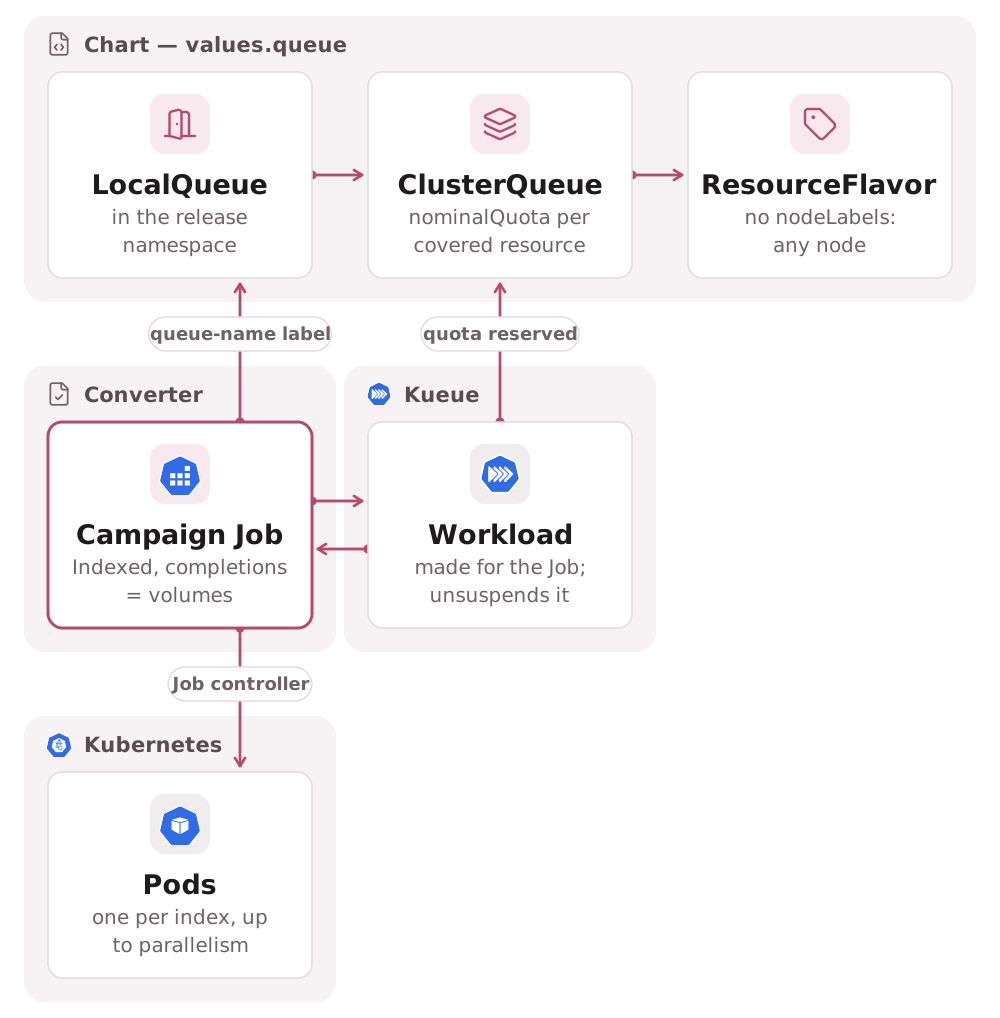
The chart renders three queue objects from queue.*, plus one priority
class per queue.priorityClasses entry
(Chart Values):
| Object | Name | What it carries |
|---|---|---|
ResourceFlavor |
queue.flavor (default default-flavor), or one per queue.flavors entry |
By default nothing: with no nodeLabels or nodeTaints, Kueue injects no nodeSelector at admission. A queue.flavors entry carries its node labels, and its taints with tolerations for them (Several sorts of GPU) |
ClusterQueue |
<queue.name>-cq (default htr-batch-cq) |
One resource group, with one flavor or the queue.flavors in their order, nominalQuota per covered resource and flavor, and a namespaceSelector on kubernetes.io/metadata.name. A ClusterQueue is cluster-scoped, so the selector keeps any other namespace from pointing a LocalQueue at this quota |
LocalQueue |
queue.name (default htr-batch), in the release namespace |
spec.clusterQueue pointing at the ClusterQueue. Jobs name this queue in their queue-name label |
WorkloadPriorityClass |
one per queue.priorityClasses entry (default htr-interactive 1000, htr-bulk 0, htr-idle -10) |
value and a description. Cluster-scoped, so the names are the same for every namespace. A campaign names one in its priority-class label |
The default quota is cpu 4, memory 8 Gi, nvidia.com/gpu 1, which is
exactly one wrapper pod. Kueue marks a Workload inadmissible unless the
ClusterQueue covers every resource its pod requests. So the covered list
and the pod's requests have to change together. Raise the quotas to run more
volumes at once.
Everything else on the ClusterQueue is Kueue's own default:
queueingStrategy: BestEffortFIFOpreemption.withinClusterQueue: NeverstopPolicy: None- no
cohort
Priority is where the classes come in. Kueue orders the queue by class value
first, higher first, and by creation time within a value, so a campaign on
htr-interactive is admitted before every waiting campaign on htr-bulk.
None of this evicts a running campaign: with withinClusterQueue: Never a
higher class goes ahead of what is waiting, never of what is running.
What the converter puts on a Job
The converter puts two Kueue labels on each campaign Job
(render._campaign_job), and no annotations:
kueue.x-k8s.io/queue-name: <queue from converter.yaml>, always.kueue.x-k8s.io/priority-class: <priority>, only when the campaign setspriority:. A Job with no label ranks at 0, which is whyhtr-bulksits at 0: naming it is the same as leaving the field out.
A pipeline that names a size
also puts its requests and limits on the wrapper, and, when the size names a
flavor, that flavor's node labels in the pod's nodeSelector.
Several sorts of GPU
A cluster with more than one sort of GPU describes each in queue.flavors:
a name, the nodeLabels its nodes carry, optional nodeTaints, and a quota
for cpu, memory and nvidia.com/gpu. The chart renders one
ResourceFlavor per entry and one resource group in the ClusterQueue, with the
flavors in the order the list gives them.
queue:
  flavors:
    - name: small-gpu      # the cheaper card first
      nodeLabels: { nvidia.com/gpu.product: <product label of the small card> }
      quota: { cpu: 8, memory: 32Gi, nvidia.com/gpu: 4 }
    - name: large-gpu
      nodeLabels: { nvidia.com/gpu.product: <product label of the large card> }
      nodeTaints: [{ key: gpu-pool, value: large, effect: NoSchedule }]
      quota: { cpu: 16, memory: 128Gi, nvidia.com/gpu: 2 }
List the cheapest card first. A pod that names no flavor (a pipeline with
no size, or a size with no flavor) takes the first flavor with room, so an
expensive card first would take its quota for light work. converter.yaml's
default_size puts pipelines without a size on a size of the operator's
choosing (Pod sizes).
What Kueue does with them:
- Order. For each Workload, Kueue tries the group's flavors in order and admits the Workload on the first whose quota it fits.
- Node selector. A flavor is skipped when the pod's
nodeSelector(or required node affinity) contradicts the flavor'snodeLabelson a key the flavor names. A pod that says nothing about those keys may land on any flavor. - Injection. At admission Kueue writes the chosen flavor's
nodeLabelsinto the pod template as itsnodeSelector, and adds the flavor'stolerations. So the pod goes to nodes with that card, whatever the Job said. - Taints. A flavor's
nodeTaintsare the taints its nodes carry. Kueue admits a Workload on the flavor only if its pods tolerate them, counting the flavor's own tolerations. The chart gives each flavor a toleration for each of its taints, so campaigns reach a tainted pool without a toleration inconverter.yaml.
A Job cannot ask Kueue for a flavor by name. It picks one through its node
selector. So a size in converter.yaml that names a flavor renders that
flavor's nodeLabels into the Job's nodeSelector. That keeps Kueue off
another flavor only if the other flavor names one of the same label keys
with a different value: Kueue compares a pod's selector with a flavor on
that flavor's own keys alone. Flavors labelled pool: large and
nvidia.com/gpu.product: <small card> share no key, so a pod meant for the
small card can be admitted on the large one. Kueue then adds pool: large
to its selector, and the pod waits Pending, holding the large card's quota.
So every two flavors must name a label key in common, with different
values. Give every flavor the same key, such as
nvidia.com/gpu.product, with a value of its own. The chart refuses
queue.flavors that break the rule, and validate refuses the same in
converter.yaml's flavors.
converter.yaml's flavors repeats the chart's names and labels. Before it
sends a campaign whose size names a flavor, apply reads the release's
LocalQueue, its ClusterQueue and each of that queue's ResourceFlavors, by
name, and holds the campaign back when they differ:
campaign kyrk runs at size large, on flavor large-gpu, and converter.yaml's flavors are not ClusterQueue htr-batch-cq's: flavor large-gpu is nvidia.com/gpu.product=<card> in the cluster and nvidia.com/gpu.product=<other> in converter.yaml — …
The chart's apply identity may make those three reads and no other outside its namespace (a ClusterRole naming exactly those objects, read-only). A kubeconfig that may not read them gets a warning, and the campaign goes out unchecked. A size with no flavor, and a pipeline with no size, may land on any flavor that has the quota.
Moving from one flavor to several. Setting queue.flavors takes
default-flavor out of the ClusterQueue. Kueue does not evict a Workload
already admitted on it. The Workload runs to the end, and its usage is
counted against a flavor the queue no longer has, so the new flavors' quotas
do not see it. Until it finishes, Kueue can admit more pods than the nodes
hold, and those wait Pending. Switch when nothing is admitted: let running
campaigns finish, or pause them (suspend: true), upgrade, and resume them.
A resumed campaign is admitted afresh on the new flavors.
The model cache is one PVC. Campaign pods on every flavor's nodes mount it,
so on more than one node it needs an access mode those nodes share
(modelCache.accessModes in Chart Values).
What a Workload holds
Kueue creates one Workload per Job, named job-<campaign>-<hash>, owned by
the Job. Its label kueue.x-k8s.io/job-uid is the link cluster.py selects
it by. spec.active is the pause lever. spec.podSets[0] copies the pod
template with a count equal to the Job's parallelism, not its
completions: a podSet describes the pods that exist at once. Quota counts
pod requests: the wrapper requests 8 Gi of memory with a 16 Gi limit, and
8 Gi is what the quota sees. At a named size, request and limit are one
number.
The webhooks and reconcilers Kueue adds
mjob.kb.io(mutating, CREATE,failurePolicy: Fail) setsspec.suspend: trueon a Job with a queue label, so it cannot run before Kueue has seen it.vjob.kb.io(validating) rejects changes Kueue cannot honour on a managed Job. It does not check thepriority-classlabel: a Job naming a class that does not exist gets no Workload and no event, and stays "Queued" for ever. That is whyhtrflow-campaigns validaterefuses apriority:outsideconverter.yaml'spriority_classes, the list that mirrors the chart's.- The Job reconciler creates the Workload, sets
spec.suspend: falseon admission, and marks the WorkloadFinishedwhen the Job ends. - The scheduler/quota reconciler picks the next Workload per ClusterQueue, assigns flavors and reserves quota.
The admission cycle
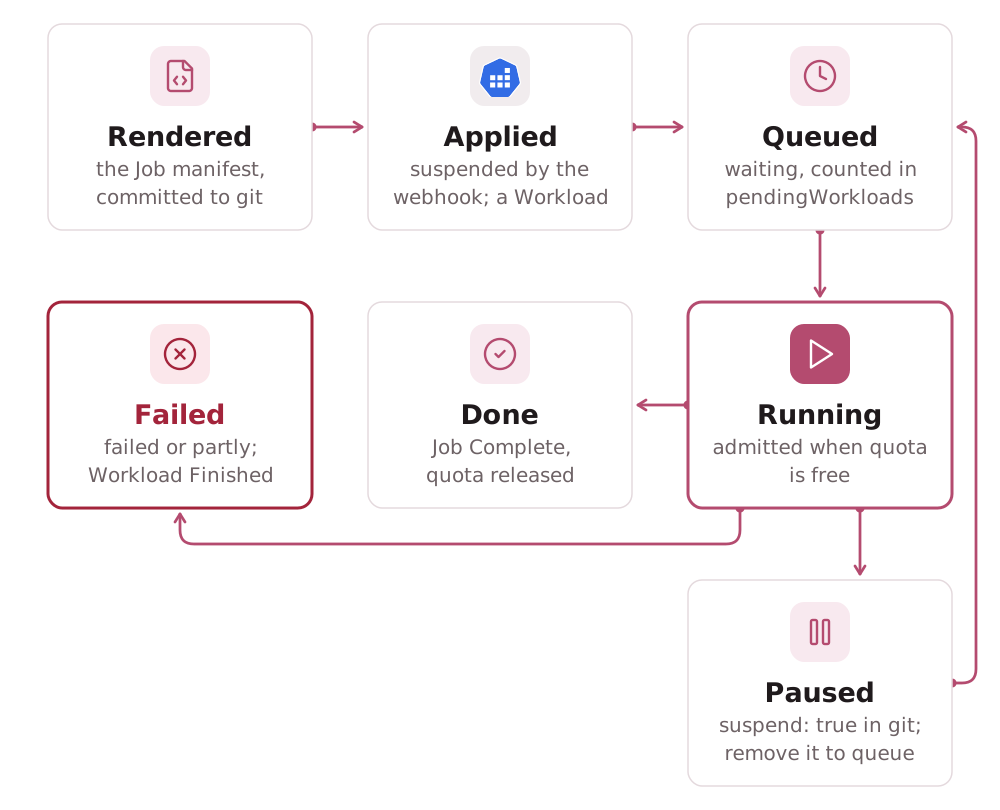
Step by step, with the controller that acts at each step:
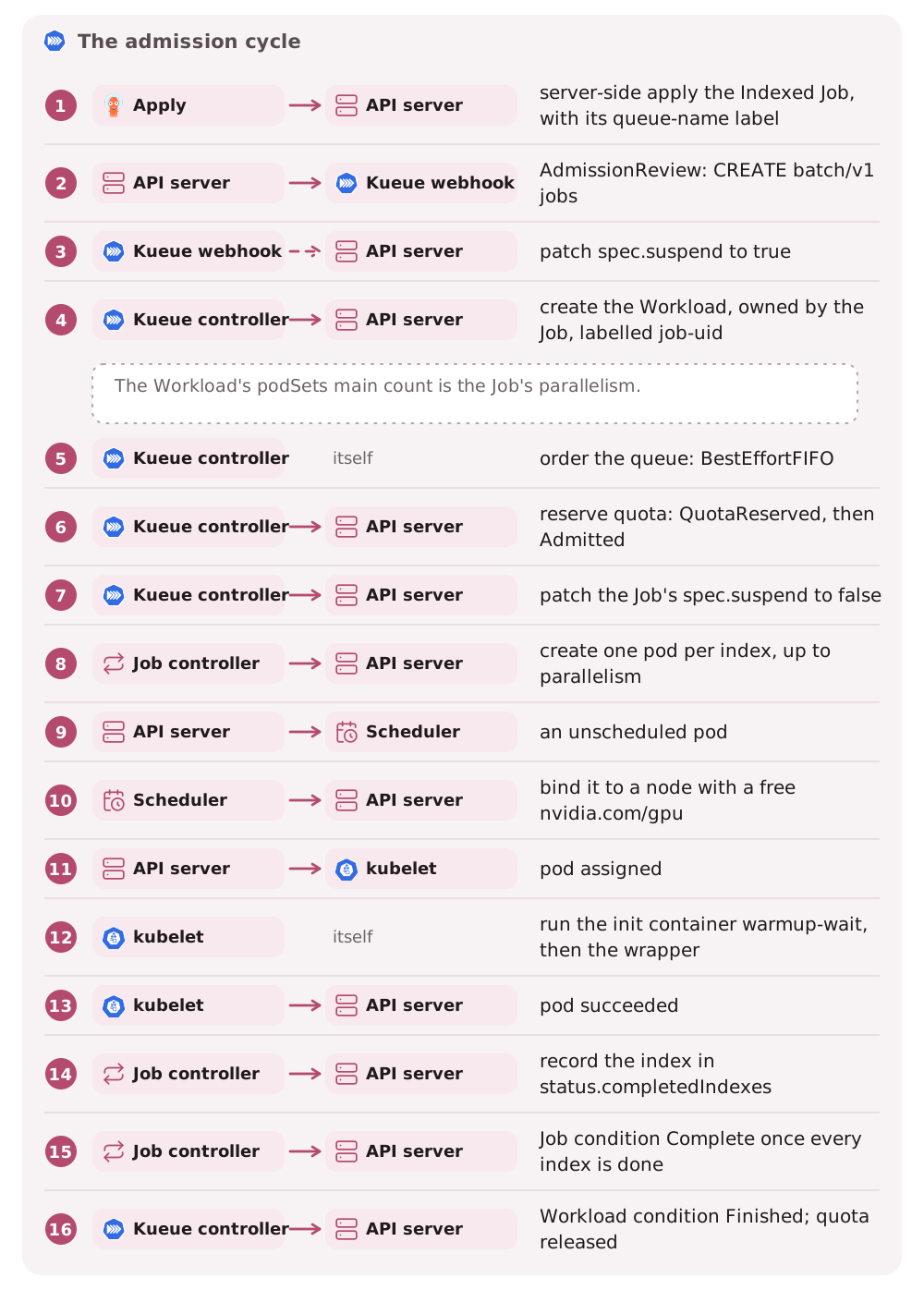
Notes on the steps that are not obvious from the diagram:
- Queue order. With
BestEffortFIFO, an older Workload that cannot be admitted does not block a newer one that fits. QuotaReserved, thenAdmitted. Quota reservation is the scheduling decision, and admission is the authorisation that follows it.- Binding.
kube-schedulerplaces each pod usingruntimeClassName, the GPU request, and anynodeSelectorandtolerationsthatrender._schedulingwrote. The empty flavor adds nothing.
Admission is per Job, not per index. Steps 8 to 11 repeat without asking Kueue again: Kubernetes replaces each finished pod with the next index. The campaign at the front of the queue therefore holds its GPU until its last index is done.
The warm-up Job is outside all of this. manifests/warmup-job.yaml carries
no queue-name label, so Kueue never sees it. It requests cpu: 2,
memory: 4Gi and no nvidia.com/gpu, so it runs alongside an admitted
campaign pod. It still gets the campaign Job's runtimeClassName,
nodeSelector and tolerations from render._scheduling, so it lands where
the model cache PVC can be mounted
(The Wrapper).
Pause
suspend: true in the campaign file renders spec.suspend: true, but that
field cannot be the lever. Kueue owns spec.suspend on a Job it manages,
and sets it back within seconds. The lever that holds is the Workload's
spec.active. Setting it to false evicts a running Workload and stops it
being requeued.
So every apply runs cluster.sync_pause after it has applied the objects
and before it prunes:
- It finds the Workload by
kueue.x-k8s.io/job-uid. - Where
spec.activedisagrees with the intent in git, it sends the merge patch{"spec": {"active": <want>}}. A Workload that already agrees gets no patch, so re-applying an unchanged repo changes nothing. - A brand-new paused campaign has no Workload for a moment, and that moment
is exactly when Kueue would admit it. So the apply polls for
--pause-waitseconds and exits non-zero if no Workload appears.
How the apply pauses a Job the API server refused, and what it does when a Workload cannot be patched, is in htrflow-campaigns CLI.
Deactivating a Workload evicts its pods and keeps every completed index. The
Job then reads suspend: true. Reactivating continues from the next index.
Resuming has one trap in server-side apply. A campaign paused before Kueue
ever admitted it (a full queue) has spec.suspend: true owned by the
apply's field manager alone. The resuming render no longer carries the
field, and a field its last owner stops sending is removed, so the API
server would put the default back: false, a Job that starts at once with
no admission. The apply therefore hands the field to a second field manager
of its own, htrflow-campaigns-suspend, first. That apply sends the same
value and is never forced, so the field stays true until Kueue admits the
reactivated Workload and flips it.
Pausing costs list and patch on workloads (templates/apply-rbac.yaml,
when the apply runs in-cluster). It also relies on Kueue behaviour that Kueue
does not promise to keep. The campaign-file side is in
Campaign & Pipeline YAML.
The window
Kueue supports partial admission. With the annotation
kueue.x-k8s.io/job-min-parallelism on a Job, Kueue may start it with fewer
pods than it asked for, once borrowing and preemption are exhausted. The
converter does not use this. Partial admission rewrites spec.parallelism on
the live Job, and the validating webhook then refuses every later apply of
the unchanged rendered file.
The converter clamps at render time instead:
parallelism = min(campaign window, converter.yaml window), with
converter.yaml's window as the per-cluster cap. The whole podSet count
must fit the quota, or nothing starts. Set converter.yaml's window so
that window × per-pod requests fits nominalQuota.
Changing the window of a campaign that is running restarts it. Kueue counts
an admitted Job's pods as min(parallelism, completions), and a Job whose
count no longer matches its Workload has every pod stopped and is queued
again. So apply compares that count on each live campaign Job that is not
suspended and has not ended with the render's, and when they differ it sends
nothing. The way through is to pause the campaign, change its window, then
resume it: a suspended Job's Workload is updated in place.
Many campaigns at once
Fifty campaigns against a one-GPU quota make fifty Jobs and fifty
Workloads: one admitted, forty-nine counted in pendingWorkloads. With a
podSet of one nothing smaller can slip through, so it behaves as a plain
queue, and the campaign at the front owns the GPU until its last index
finishes, whether that takes minutes or weeks.
Preemption and cohorts
Both are off. The ClusterQueue keeps Kueue's defaults (every preemption
policy Never, stopPolicy: None) and has no spec.cohort, so there is no
quota to borrow or lend.
With preemption on, a higher-priority Workload can evict an admitted one. The
victim gets Evicted with reason Preempted, and a Preempted condition
naming what displaced it. For this system that means stopping a running
volume mid-transcription. The volume survives, because the wrapper resumes
from its published pages, but it is a policy choice rather than a switch. A
cohort would let the queue borrow another tenant's idle quota. The chart
ships the WorkloadPriorityClass objects preemption would rank by; what it
does not do is turn preemption on.
Who owns which field
| Field | Owner | Note |
|---|---|---|
job.spec.suspend |
Kueue | Set true by the webhook at CREATE, and false by the reconciler at admission. The apply sets it true for a paused campaign, and holds it there through a resume (see Pause) |
Job label kueue.x-k8s.io/queue-name |
converter | Effectively immutable once admitted: removing it releases no quota and blocks resuming |
completions, parallelism, backoffLimitPerIndex, maxFailedIndexes, podFailurePolicy, ttlSecondsAfterFinished |
converter | Kueue reads parallelism into the podSet and ignores the rest |
pod.spec.containers[*].resources.requests |
converter | The numbers quota is counted in |
job.status.completedIndexes, failedIndexes, conditions |
Kubernetes Job controller | The only progress the status page reads |
workload.spec.active |
htrflow-campaigns apply, by patch |
The pause lever |
workload.spec.podSets, status.admission, conditions |
Kueue | Nothing else writes these |
| Pod placement and binding | kube-scheduler | Kueue contributes the admitted flavor's nodeLabels and tolerations. The default flavor has neither |
Failure interplay
Kueue watches a Job's completion and failure, and nothing finer.
- A pod failure is invisible to Kueue. The Job controller retries the
index under
backoffLimitPerIndex, and the Workload keeps its admission, and its GPU, throughout. FailIndex(thepodFailurePolicyrules for exit 13 fromwrapperorwarmup-wait) fails the index with no retry. Kueue does not see it unlessmaxFailedIndexesis exceeded and the Job goesFailed. The Workload is thenFinishedand the quota is released.activeDeadlineSecondssits on the pod template, so the kubelet kills the pod at the deadline and the Job retries the index. It is not Kueue'smaximumExecutionTimeSeconds, which is not set.- TTL.
ttlSecondsAfterFinisheddeletes the Job a week after it finishes —converter.yaml's default, which a pipeline may set for itself — and the Workload, as an owned child, goes with it.
The whole failure model is in Failure Handling.
Reading the queue
The commands for a campaign that is not admitted, the Workload conditions to look for, and what "Queued" means on a campaign card are in Troubleshooting.
Known limits
- The pause patches Kueue's Workload directly.
sync_pauseneedspatchonworkloadsand relies on eviction byspec.active, which Kueue does not promise to keep. If a Kueue release changes that, the symptom is a campaign git says is paused that keeps running. - Priority orders the queue; preemption is off. A campaign's
priority:decides who is admitted next and never evicts a running campaign. While one campaign holds the whole quota, "next" is when that campaign's quota comes back. Preemption would stop a running volume mid-transcription (resume makes that survivable), and turning it on is a product decision rather than a switch. windowis not checked against the quota. Without partial admission the whole podSet must fit. The shipped defaults (converterwindow20 against a one-GPU quota) renderparallelism: 20, which is inadmissible forever and reads only as "Queued".- A size is not checked against the quota.
validatedoes not know the chart's quotas, andapplycompares node labels, not numbers. A size that asks for more than any flavor it may land on has, or a size whose flavor's quota is smaller than it, is inadmissible forever and reads only as "Queued". Size each flavor's quota for at least one pod of the largest size that can land on it. - A reaped campaign is remembered by a ConfigMap, not by Kueue. The
Workload is deleted with the Job, so the queue itself remembers nothing.
What stops the next apply from running every index again is the campaign's
status ConfigMap:
applywrites how the Job ended before it applies anything, and then leaves a finished campaign alone (Campaigns). A campaign's volume list is append-only, so a finished campaign is never run again: new volumes go in a new campaign.