Cache layer
A proposal, not built: a read-through cache layer between campaign pods and the IIIF origin, beyond the S3 image cache that already exists. Build it only when measurements from real campaigns show it is needed. This page covers the evidence that would justify it, two ways to build it, what each one promises, how each one fails, and the spike that decides between them.
What happens today
The wrapper fetches pages straight from the IIIF origin (Page flow, The Wrapper):
- Downloads start as soon as the stream is built, so they overlap the model load.
- A bounded pool (
DOWNLOAD_CONCURRENCY) fills a bounded lookahead window (LOOKAHEAD_PAGES) on a memory-backed workdir. The GPU consumes pages as they land, and each image is deleted once its outcome is recorded. - Each image URL comes from the canvas's image service in the source
manifest, capped at
MAX_IMAGE_WIDTH. Volumes listed as plainimages:are fetched at the URL given. - An S3 image cache can be switched on (Deploy → Cache source images). Each page's image is looked for in a private bucket first and stored there after a download, so a retry or a re-run under a new pipeline reads the pages it holds from the bucket, not the origin (The Wrapper → Image cache). Without it, every such run fetches every page it processes again.
Streaming already caps the GPU's wait at about one page's download at the start, plus any moments the origin falls behind, and the S3 image cache already answers repeat fetches. The two variants below are the next step, for when the evidence shows idle GPUs or origin load: they add prefetching ahead of the queue, and shield the origin on a volume's first read too.
The evidence that would justify it
Every completed volume's manifest.json records the numbers needed
(S3 Layout):
| Field | What it measures |
|---|---|
wall_seconds |
the whole run, from the wrapper's start to the last write |
gpu_stall_seconds |
time the consumer waited for the next page to land: the fetch time the GPU actually felt |
results.<page>.seconds |
processing time for each page that reached the pipeline |
bytes_fetched |
image bytes this run downloaded from the origin; pages read from the S3 image cache add nothing |
pages, pages_per_second |
volume size and throughput |
Fetch time itself is not recorded. Downloads run concurrently and ahead of
the GPU, so their sum would not measure what they cost; stall does.
Per-page download latency, if it is wanted, is a small addition to
results.
Nothing aggregates these yet. A one-off over the manifests of one pipeline
does it (use <namespace>/ in front only when the release sets
S3_PREFIX):
aws s3 cp --recursive "s3://<bucket>/<namespace>/<pipeline>/" ./manifests \
  --exclude '*' --include '*/manifest.json'
find ./manifests -name manifest.json -print0 | xargs -0 jq -s '
  { volumes: length,
    wall:  (map(.wall_seconds) | add),
    stall: (map(.gpu_stall_seconds) | add),
    gpu:   (map([.results[] | select(.status == "ok") | .seconds] | add // 0) | add),
    bytes: (map(.bytes_fetched) | add) }
  | .stall_fraction = (.stall / .wall)'
Build the cache when one of these holds across an archive-scale campaign, not a handful of volumes:
- GPU idle. The aggregate
stall_fractionstays above roughly ten per cent. - Origin load. The origin rate-limits or fails under backfill:
429and5xxfetch errors in the run logs, and page failures they explain. - Repeat fetches. The same volumes are fetched again and again, through
retries, re-runs under new pipeline ids or several tenants.
bytes_fetchedsummed per volume across runs shows how much. The S3 image cache is the answer built for this one; its hits and misses are in eachmanifest.json'simage_cache.
What both variants keep
- Read-through. A page never prefetched is fetched on first read. The cache accelerates and is never a correctness dependency: if it is cold or gone, Jobs are slower, not broken.
- Width in the key. The requested width stays part of the cache key, so
a cached image can never be served at the wrong resolution. The built S3
image cache deliberately does not do this: operators fixed its key as
{ref}/{ref}_{page:05d}.jpg, with no width, so a cached image is reused at whatever width first stored it. - Queue-aware warming. Warming at submit time would push hundreds of volumes through the cache hours before they run, and evict each other on the way. A small warmer instead prefetches only the next few volumes that will actually run:
- the pending indexes of admitted campaigns
- then the first lines of the queued campaigns, in admission order
It reads Jobs, Workloads and each campaign's volumes.txt ConfigMap, and
drops warm data for completed volumes. Its death only makes Jobs colder.
Variant A: caching HTTP proxy
One proxy Deployment with its cache on a memory-backed emptyDir (or a
disk, for reuse across campaigns), plus the warmer.
proxy_cache_path /cache levels=1:2 keys_zone=iiif:64m
                 max_size=<cache-size> inactive=24h use_temp_path=off;
server {
  listen 8080;
  location / {
    proxy_pass https://<iiif-origin>;
    proxy_ssl_server_name on;
    proxy_cache iiif;
    proxy_cache_valid 200 7d;
    proxy_cache_lock on;                          # collapses concurrent misses
    proxy_ignore_headers Cache-Control Expires;   # IIIF image URLs are immutable
    add_header X-Cache-Status $upstream_cache_status;
  }
}
Contract.
- The proxy serves
GET <image-path>byte-identical to the origin. The full URL, including the width segment, is the cache key. - The wrapper takes image URLs from the manifest, so there is no base URL to
repoint. The wrapper needs a setting that maps
<iiif-origin>to the proxy for image requests, and it falls back to the origin when the proxy errors. - Campaign pods' IIIF egress can then narrow to the proxy.
Failure modes.
| Failure | Effect | Recovery |
|---|---|---|
| proxy down | fetches fall back to the origin | none needed, slower |
| cache full | least-recently-used entries evicted | read-through |
| proxy restarts on a memory-backed cache | cache empty | read-through, warmer refills |
| warmer down or behind | cold reads | read-through |
| origin down | misses fail, cached pages still served | Job retry |
Variant B: Fluid, Alluxio and an index shim
A data layer that makes every volume a read-only directory on a FUSE mount, cached in memory on the GPU nodes. Campaign pods do no downloading.
What it rests on
- HTTP sources. Alluxio's web under-storage (WebUFS) mounts a plain
HTTP(S) source, and Fluid's own samples mount a public HTTPS mirror as a
Datasetthis way. - How WebUFS lists. It builds its namespace by parsing HTML directory index pages:
- a
text/htmlpage whose title carries a configured marker (such asIndex of) is a directory - configured parent-link names are skipped
- every remaining link is an entry
It is read-only: every write operation is refused.
- File metadata. WebUFS takes a file's size from Content-Length and its
mtime from Last-Modified on a HEAD, parsed with a configured date
format. The timeout, date format, title markers and parent names are
properties.
- Warming. Fluid's DataLoad resource preloads a path of a Dataset
into the runtime's cache.
- The gap. IIIF serves JSON manifests and parameterised image URLs, not
directory index pages, so it cannot be mounted directly. A small stateless
index shim makes it look like one.
These come from Fluid's samples on accelerating web data access and data warm-up, and from the Alluxio web under-storage source.
Architecture
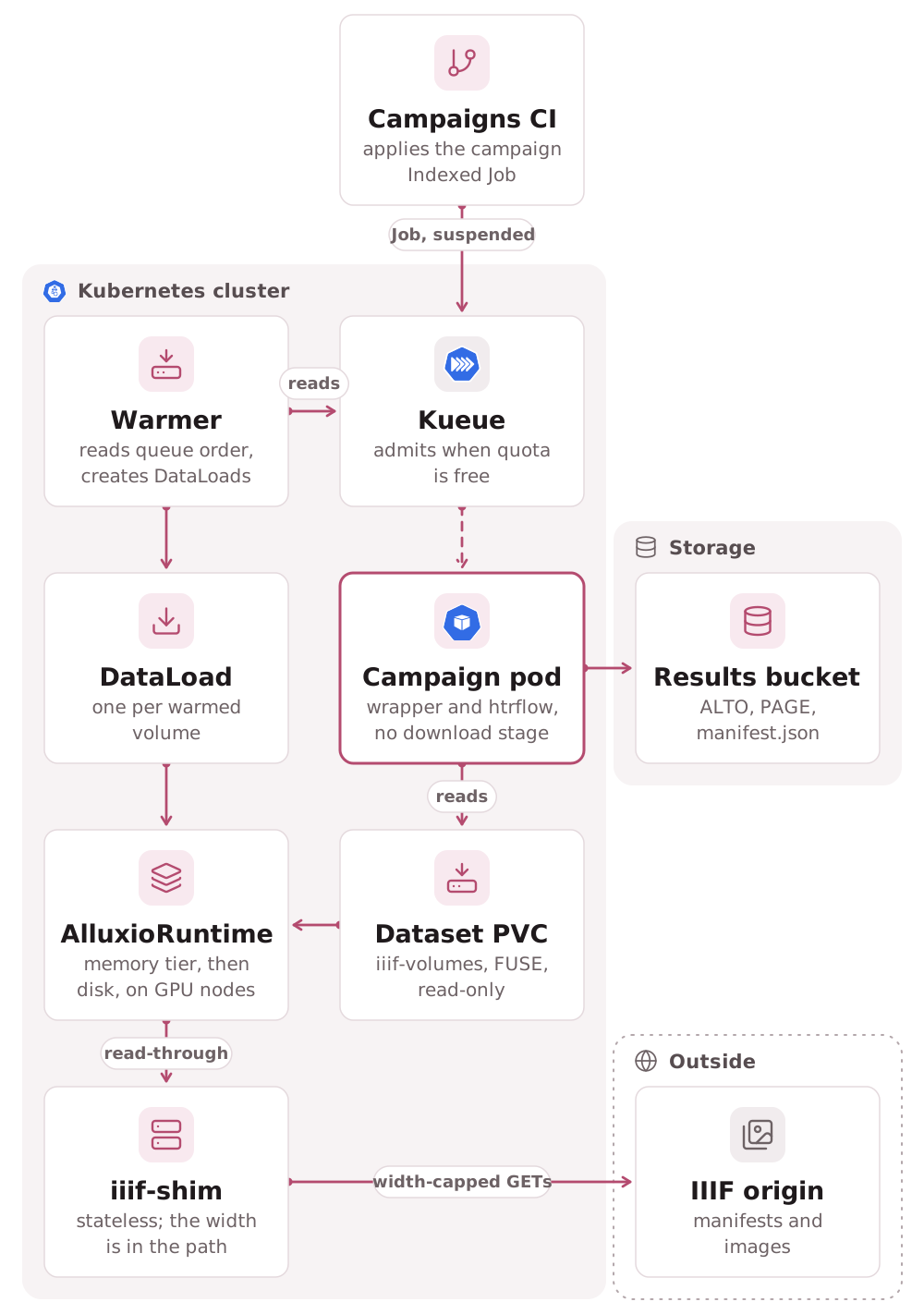
| Piece | Owns | Does not own |
|---|---|---|
| Kueue | when: GPU quota, queue order | data, placement |
| warmer | queue-aware prefetch: DataLoads for the next volumes only | correctness |
| Fluid and Alluxio | where: cache tiers, prefetch execution, placement affinity | queueing, HTR |
| index shim | IIIF to filesystem: manifest to listing, URL to bytes, width cap | caching, state |
| Indexed Job | lifecycle: retries, deadlines, completion | queueing |
| wrapper | resume, invoking htrflow, verify, publish | downloading |
| htrflow | HTR | everything else, unmodified |
Kueue and Fluid do not conflict. Kueue decides when a Job runs. Fluid's webhook adds node-affinity preferences that decide where its pods land, near the cached blocks.
Warm path and miss path
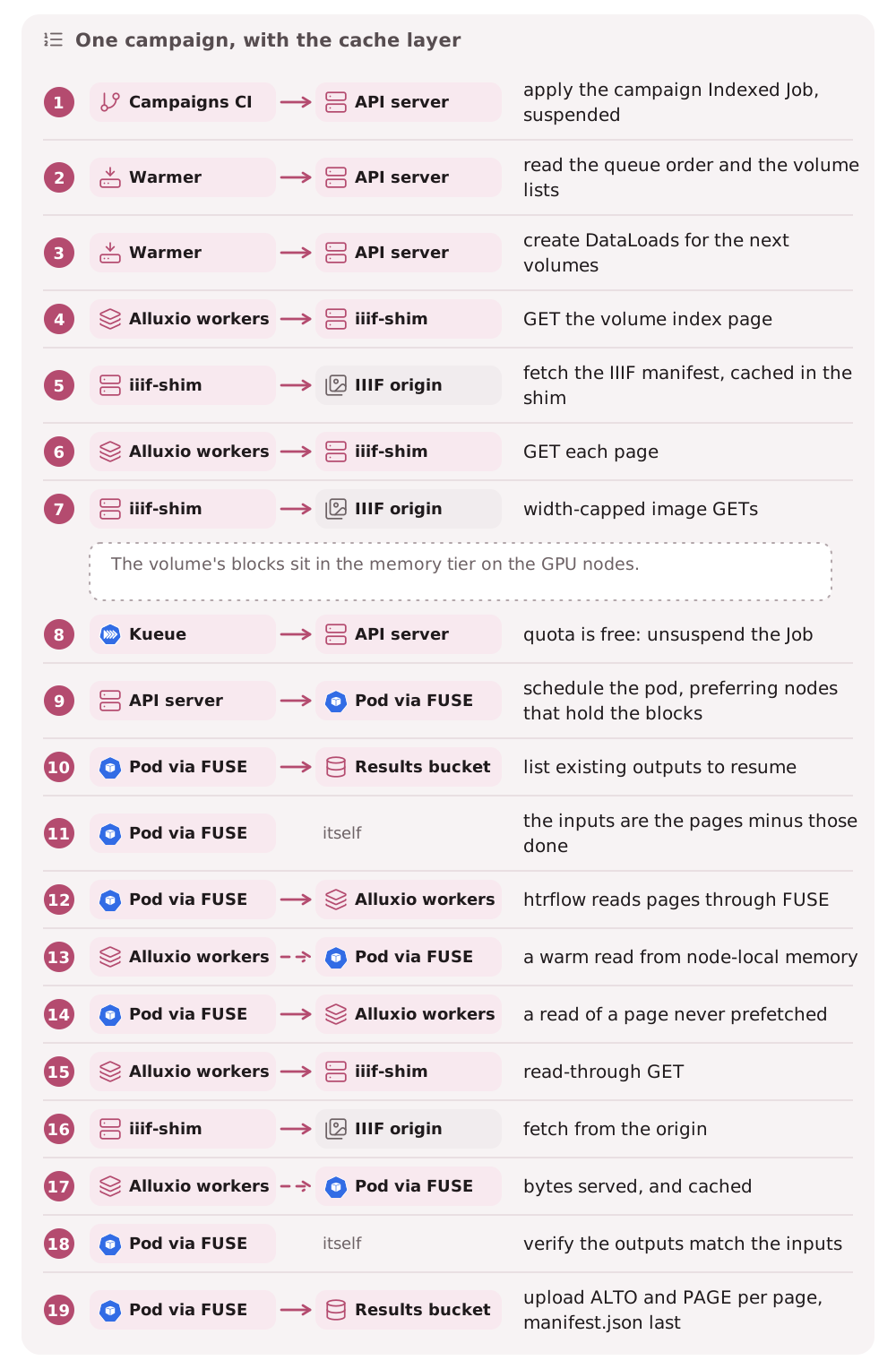
Component contracts
Index shim. A stateless Deployment with two replicas behind a Service.
| Endpoint | Returns |
|---|---|
GET /<volume-ref>/w<width>/ |
An HTML index built from the IIIF manifest: a title carrying the WebUFS directory marker, a parent link, and one NNNN.jpg link per canvas in manifest order, zero-padded. Last-Modified is in the date format WebUFS is configured with. The width is in the path, so the cache key can never disagree with the delivered resolution. |
GET /<volume-ref>/w<width>/NNNN.jpg |
Image bytes streamed from the origin at the width cap, the same request the wrapper makes today. |
HEAD /<volume-ref>/w<width>/NNNN.jpg |
Size and mtime for Alluxio. See the metadata problem below. |
GET /_meta/<volume-ref>.json |
Canvas-to-page mapping and source URLs for the wrapper's provenance record. It lives outside volume listings, so htrflow never sees it as an input. |
GET / |
A root listing, only if the spike shows Alluxio needs one. Otherwise any /<volume-ref>/ path resolves lazily. Listing live volumes from the Kubernetes API would need RBAC. |
- Manifests are cached in memory (LRU, minutes), so the origin is hit once per listing or warm, not once per page.
- Bytes are proxied, not redirected. That keeps WebUFS on one host, applies the width cap and controls the headers.
- Configuration is the origin, the allowed widths and the manifest template. No disk and no state.
The metadata problem. Alluxio wants a size and an mtime at listing time.
IIIF image servers derive images on demand and often send no
Content-Length on HEAD. The options, in order of preference:
- Stable fake sizes. The shim reports one constant size. The spike checks that Alluxio reads to the real end of the stream, without truncating or padding.
- Size on first touch. The shim fetches each derivative once and remembers its real size. Per volume this is exactly the warm traffic, so the DataLoad pays for it, not the GPU.
- Both fail. Variant B falls, and Variant A remains.
Fluid objects. One Dataset and one runtime serve the whole system:
apiVersion: data.fluid.io/v1alpha1
kind: Dataset
metadata:
  name: iiif-volumes
  namespace: <namespace>
spec:
  mounts:
    - name: volumes
      mountPoint: web://iiif-shim.<namespace>.svc:8080/
  accessModes: ["ReadOnlyMany"]
- The
AlluxioRuntimeof the same name runs a worker per GPU node, with a memory tier on/dev/shm; a disk tier is what would make reuse across campaigns real. A short metadata sync interval lets new volumes appear without a remount. - The warmer creates a
DataLoadper volume it warms, targeting/volumes/<volume-ref>/w<width>/. - The WebUFS mount options (timeouts, the
Last-Modifiedformat the shim must match) are pinned during the spike.
Campaign pod changes.
- The pod mounts the Dataset's PVC read-only, and the wrapper's input
directory becomes
volumes/<volume-ref>/w<width>/on that mount. - The fetch stage disappears: resume, run, verify, publish.
- Resume passes htrflow an inputs list, because pages cannot be deleted from a read-only mount.
- Outputs still go to the memory-backed workdir.
Memory
Images leave the pod: the lookahead window no longer lives on the workdir, so the pod's memory holds the resident models and page outputs only. Pod OOM risk stops scaling with image size. A huge volume churns the cache instead of killing a Job. The RAM moves to the Alluxio workers, which serve reads at memory speed on the same nodes.
Those workers are a standing Deployment, not queued workloads, so their memory is outside the Kueue quota. Size node capacity for both.
Failure modes
| Failure | Effect | Recovery |
|---|---|---|
| warmer down or behind | cold reads | read-through, slower |
| shim pod dies | cached pages still served, misses fail | second replica, Job retry |
| FUSE mount wedges | reads hang or fail inside htrflow | Fluid FUSE recovery, else the pod fails and the index retries |
| Alluxio evicts mid-volume | next read is a miss | read-through |
| Alluxio master down | every read fails, cached or not | a highly available master, or an accepted risk |
| origin down | misses fail, warm volumes unaffected | Job retry |
Open issues:
Content-Lengthbehaviour. Unresolved until the spike runs.- FUSE in the GPU's critical path. A stalled read looks like a hung
image read inside htrflow. The wrapper's guard watches htrflow's worker
threads for death, not for a blocked read. Timeout ownership moves from the
wrapper's own HTTP client to a FUSE daemon. Adopting Variant B needs a
watchdog on output progress: the pod's
activeDeadlineSecondsis a backstop, not an answer. - Shim scope. "Small and stateless" is the floor. A root listing from the Kubernetes API adds RBAC and watches.
- Master as a single point of failure. Run a highly available master, or accept that its outage stops every read.
- Reuse across campaigns needs a persistent tier. A memory tier cannot hold a corpus between campaigns months apart. Repeat-read savings need a disk tier sized to the corpus. Without one, Variant B's benefit is prefetch and node locality only.
Variant B also narrows egress. Campaign pods talk only to the bucket: images come through the local mount and models through the cache volume. The shim is the only component that talks to the IIIF origin.
Adoption spike
One to two days on a CPU-only cluster, before choosing Variant B:
| Check | Pass criterion |
|---|---|
| Listing | WebUFS lists the shim's index for a volume: every page, correct names and order. The WebUFS property keys are pinned for the Alluxio release in use. |
| Metadata | Every page read through the mount is byte-identical to a direct fetch from the origin, with fake sizes tolerated or size on first touch implemented. |
| Warming | A DataLoad completes, and a test pod reads the volume from the mount at node-local speed. |
| Late volumes | A new volume path becomes visible through metadata sync within about a minute, without a remount. |
| Failure | Killing the shim mid-read leaves cached pages readable and surfaces misses as read errors, not hangs. The mount recovers when the shim returns. |
If the metadata check fails, Variant B falls. Variant A needs no change to the wrapper's design, since the wrapper keeps its download stage.
Choosing
- Variant A is a small fraction of the operating surface and solves prefetch and origin shielding. If the evidence shows idle GPUs or origin load, start here.
- Variant B adds node-local reads, declarative warming, placement near the data, and a data layer other pipelines can share. It costs operating Fluid, Alluxio and the shim. Reach for it only if the data layer will be shared beyond this system, or if origin load demands persistent caching at corpus scale.